Steve Browning

Steve Browning
Clubs & Associations
- Foggy City Dancers
- Foggy City Squares
- Midnight Squares
- South Florida Mustangs (Honorary Member)
Quick Facts
- partner of Rob Rothfarb
- participated in Pink Triangles in Red Square, 1993
GCA Caller School
- attended 2005
Medallion Dancer
- 1993 | 10 Year Medallion at Remake The Circle
- 2003 | 20 Year Medallion at Anchors Aweigh With a Half-Sashay
- 2008 | 25 Year Medallion at Touch A Quarter Century
Photos

Karl Jaeckel and Steve Browning at Stars, Thars and Cable Cars, 1996
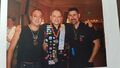
At Star Thru The Silicon Galaxy, 2005
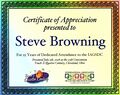
Certificate received at Touch A Quarter Century, 2008

1981 Foggy City Squares performance on Castro. Steve Browning and Kurt Bruens

1981 Foggy City Squares performance on Castro. Steve Browning and Kurt Bruens

undated
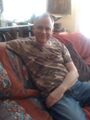
undated


Videos
You can find them all by doing a search for "Foggy City Dancers:" You’ll get a lot of stuff, but mine should be obvious. They will either have the dance name (Trouble, Boogie Grass Band) or just have "Performance Team". I put some video references for most figures.
Steve's Interview Notes made 1/25/10 in preparation for an interview with Allan Hurst on 1/27/10.
Square Dance Choreography By Steve Browning
My History:
- 1982: Started Square Dancing with Foggy City Squares
- 1983: Danced in the original Foggy City Exhibition Team (with Skip Barrett) for 6 months
- 1984: Skip sells Foggy City Squares to Foggy City team members and name changed to Foggy City Dancers (FCD)
- 1984: I approach the "new" Foggy City Dancers team to see if they would like to me to attempt some more creative choreography. The answer was, of course "Yes, Yes, YES"! see Foggy City Dancers Performance Team
- 1984: Seattle convention was the team’s first performance under my direction.
- 1985: First fully choreographed performances done at the Promenade Along The Rockies Convention.
- 1986: Hexagon concept debuted at the Star Thru The Golden Gate convention (more on this later)
- 1984-1993: Choreographed for Foggy City Dancers performance team. Performed at all conventions during that time. The team disbanded shortly after we returned from Pink Triangles in Red Square, our exciting trip to Russia!
- 1995: Reformed a new team to do an encore performance at the 1996 convention in Stars, Thars and Cable Cars.
- 2008: Attended my 25th consecutive convention in Touch A Quarter Century.
In the Beginning:
I started thinking about interesting square dance patterns right from the start. This was well before we had any experience with great professional callers (like Mike DeSisto). So I was fantasizing about it all on my own! However, in 1983 Midnight Squares danced at the Golden State Roundup in the Civic Auditorium and that was an eye opening experience for me!. I saw my first Grand March and I was amazed at the spectacle. And the kaleidoscopic motion, patterns and colors that filled the entire auditorium when square dancing began, was mesmerizing. However, it was the Saturday night performance by the SquareNaders that really transfixed me and gave me the inspiration to take on the task of choreographer for the Foggy City Dancers team. You will find those videos at the bottom.
Example 1: 2 squares dancing side by side and an 8-chain thru is called. What would happen if the side (or head) couples continued right on into the next square. (Video: 1992 Diamonds In The Desert, Well Traveled Love)
Example 2: 2 squares (again). And what about a Relay the Duecy that "joins" both squares and goes all the way through. Presto! The squares switch positions. (Video: 1992 Diamonds In The Desert, Well Traveled Love and 1986 Star Thru The Golden Gate convention, Mama Don’t Allow)
Example 3: And let’s not leave out Spin Chain and Exchange the Gears! Plus level has many many calls that work really well for interesting choreography.
Ok, the examples are endless, but bottom line is that I actually got a chance to try out my ideas with the Foggy City Dancers Performance Team!
Figures/Concepts that I pioneered (invented?)
Hexagon: 3 head and 3 side couples arranged in a circle. I had LOTS of fun with this concept and feel that I invented it! (Video: 1986 [[Star Thru The Golden Gate] convention, Mama Don’t Allow and 1992 Diamonds In The Desert, Mountain Music)
Big Square: 8 couples w/4 heads and 4 sides. Head and side couples facing each other (Video: 1986 Star Thru The Golden Gate convention, Mama Don’t Allow)
Octagon: 8 couples w/4 heads and 4 sides. Head/sides alternating with each other (like in Hexagon) (Video: 1992 Diamonds In The Desert, Mountain Music)
Triangle: 3 couples doing fun stuff
2 Squares: Mixing them up a bit with 8-chains, Relay the Ducey, Spin Change the Gears (and variations), Prom to opposite square, and more! (Video: 1986 Star Thru The Golden Gate convention, 2nd number…hash music and 1992 Diamonds In The Desert, Well Traveled Love)
Sequential: I had 4, 2 couple ’squares’ doing the same sequence of calls, but each square starting 8 beats after the one before.
(Video: 1986 Star Thru The Golden Gate convention, 2nd number - hash music)
Transformation: I also enjoyed starting off with one concept (like Hexagon) and then bring in 2 more couples during the middle break and transform the hex into an Octagon or Big Square or 2 Squares. Then I do 2 more figures from the configuration.
(Video: 1986 Star Thru The Golden Gate convention, Mama Don’t Allow and 1992 Diamonds In The Desert, Mountain Music)
Creative Process:
- The first fully choreographed number was done using "generic" hash music and the music was modified to fit my choreography. However, once I gained a bit of experience and confidence,
I set about doing choreography that fit the structure of singing calls. And I stayed within the Singing call structure except for one thing…..I knew right from the beginning that I did not (could Not) have the follows dance with each of the leads. Not enough counts or figures to do this for a Hexagon (for example) and besides, it just wasn’t necessary.
- Singing Calls: When these are chosen carefully, they provide the best music for doing exhibition Dancing. And I found it fairly easy to fit my patterns to the Singing call structure:
There are seven parts – 64 counts each, as follows:
- Intro (involves entire square, or squares or hex)
- Figure 1 (heads)
- Figure 2 (heads)
- Middle figure (entire square)
- Figure 3 (sides)
- Figure 4 (sides)
- Ending figure
- Other Music: Also wrote figures for non square dance songs. (such as Well Traveled Love and Turn Me ’Round – K.D. Lang)
- Music: I spent a lot of time browsing through 45’s (that’s the way it was back then) to find singing calls that were exciting and fun to dance too. Also keep my ears open for popular songs that had the right beat for dancing.
- My Little People: I created my own caller checkers for working out choreography.
- Process (figures): I would usually get an idea for a figure based up an interesting s.d. call. I would have an idea about how I would like the figure to end using that call. Then I would back it up from there and see what position I need to get the dancers into before starting the call, in order to get them back to their partners at the end of the call.
Example: Hex using Relay the Deucy (LOVE this call!) I wanted to end the figure with the Relay, so I worked out the Relay pattern (using my Little People) and figured out where the dancers would need to begin the figure in order to bring them back to their partner and have them in the right order to promenade home.
I also got a feel for the total number of beats this would take, so then I knew how many beats I had left over in order to get them into that position. Then I worked out a series of call that would get them into position. These could include calls like all 12 circulate, Coordinate or Right/Left thru. Even simple calls are can be interesting in a Hex.
